Quick Answer
What Happens During Gate Installation?
Professional gate installation starts with a site inspection and sub-grade preparation, then moves to setting heavy-duty support posts in concrete footings, hanging and aligning the gate leaves, and wiring automation and safety sensors. The crew finishes with full system calibration, safety testing, and site clean-up. A straightforward manual gate can sometimes be hung in a single day, while an automated system typically adds electrical work, sensor placement, and cycle testing before the job is complete.
Adding a custom steel entry gate transforms your property’s curb appeal, access control, and overall security. However, if you have never worked with heavy steel fabrication before, the installation process can seem unpredictable.
Whether you are opting for a residential driveway entry or an industrial security gate, knowing what happens on installation day ensures a smooth, stress-free experience. Here is a realistic, step-by-step breakdown of what to expect when professional installers arrive on-site.
Initial Site Inspection & Sub-Grade Preparation
Before any heavy steel components arrive on a flatbed, our installation crew conducts a comprehensive walkthrough of the installation zone.
Proper groundwork prevents long-term sag, soil shift, and mechanical binding. During this phase, installers will:
- Verify Utility Locations: Ensure all underground electrical, water, and fiber optic lines are clearly marked by local utility providers.
- Assess Grade and Slope: Measure driveway pitch to ensure swing gates clear the ground or sliding gates have a level track.
- Establish Benchmarks: Set precise string lines to guide post placement and depth calculations.
Pro Tip: Clear vehicles, trash cans, and outdoor equipment at least 15 feet back from the installation site before the crew arrives to keep the workspace safe and clear.
Setting Heavy-Duty Support Posts
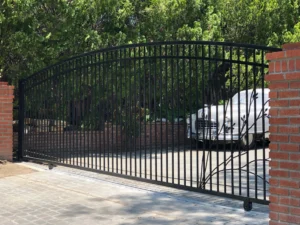
The structural integrity of any steel gate relies on its support posts. Steel gates — especially heavy, ornamental double-leaf swing gates — exert massive cantilever forces on support points.
Installers dig post holes well below the local frost line to prevent seasonal ground heave. Heavy-gauge steel posts are set into the ground using high-strength concrete footings.
Because concrete requires curing time to achieve structural strength, the gate leaves themselves are typically hung after the footings set completely, or braced securely with temporary support rigging if installed same-day.
To learn more about how custom support frames are constructed, explore our custom steel fabrication services.
Hanging, Alignment, and Hinge Adjustment
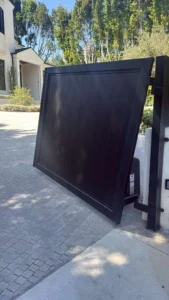
Once the support structure is anchored, the gate leaves are hoisted into position using crane lifts or manual chain hoists. Precision alignment is where professional experience pays off:
- Hinge Mounting: Heavy-duty ball-bearing hinges are welded or bolted directly to the steel posts.
- Plumb and Level Checks: Installers adjust hinges to fractions of an inch, ensuring the gate closes without friction or gap unevenness.
- Latch and Lock Alignment: Mechanical drop rods, magnetic locks, or heavy latch plates are set and tested for smooth engagement.
If you are replacing an older structure, our guide on custom fabrication vs. prefabricated gates explains why upgrading to an engineered system pays off over time.
Automation and Electrical Access Wiring
If your project involves an automated entry system, electrical integration happens alongside the physical gate hanging. A dedicated technician connects low-voltage or line-voltage power to the automated operators.
During this stage, the crew installs:
- Operator Arm / Slide Motor: Mounted to reinforced mounting plates on the gate frame.
- Safety Sensors: Infrared photo-eyes and safety loop detectors embedded in the asphalt to prevent gates from closing on vehicles or pedestrians.
- Access Control Hardware: Keypads, intercom boxes, RFID card readers, or smartphone-controlled receivers mounted at the driveway approach.
For specialized access options, browse our full lineup of automatic gate operators and access control systems.
System Calibration, Safety Testing, and Clean-Up
A gate installation isn’t finished when the last bolt is tightened. The most crucial part of installation day is system calibration and safety verification.
The crew runs the gate through repeated open-and-close cycles to fine-tune speed, slowdown limits, and obstruction sensitivity. Technicians perform force tests to guarantee the gate reverses immediately upon contacting an obstacle, fully complying with UL 325 safety standards.
Finally, the job site is cleared of construction debris, weld splatter is cleaned, and touch-up paint or powder-coat seals are applied over any exposed steel fasteners.
Curious how these steps add up on a calendar? Our companion guide on how long gate installation takes breaks down realistic timelines for manual, automated, and custom commercial projects.
Ready to Secure Your Property with a Custom Steel Gate?
A professionally installed steel gate adds lasting security, convenience, and value to your property when done right the first time. At Star Steel Inc., our experienced fabrication and installation teams handle every detail from structural engineering to final electrical testing.
Whether you need a custom driveway gate or a commercial security system, we bring expert craft and heavy-duty materials to every build.
Take the first step today. Schedule a free on-site consultation with Star Steel Inc., or call our team at (818) 885-8979 to discuss your project requirements.