Quick Answer
How do you know when you need a new gate?
You likely need a new gate if the frame is bent, cracked, or rusted through at structural joints, if sagging returns after adjustment, if the posts are failing, if repairs keep recurring in different parts, or if an older gate lacks modern safety protection. If the frame is sound and only the operator has failed, you may only need a new operator.
A gate rarely fails all at once. It starts with a squeak, a slight drag, or a remote that needs two tries, and over the years it turns into a gate that needs a technician every few months. At some point, another repair stops being the smart move and a new gate becomes the better investment. The hard part is knowing when you have reached that point.
This guide walks through the clearest signs that a gate is beyond repair, explains how to tell a fixable problem from a failing structure, and covers the safety issues that often push older gates over the line.
Signs Your Gate Is Past Repair
Repairs keep coming back
One repair is normal. A pattern is not. If you fix a hinge, then a roller, then a latch, then the operator board within a short period, the gate is telling you that the whole system is worn. Compare what you have spent on repairs with a replacement quote, and weigh how much longer the old gate will realistically last.
The frame is bent, twisted, or cracked
A frame that has been hit by a vehicle, racked by wind, or overloaded by a heavy operator can twist out of square. Cracked welds are an even clearer warning because they mean the structure no longer carries load the way it was designed to. Welding a crack can help, but if the steel has fatigued or the design was never strong enough, new cracks tend to appear nearby.
Rust has reached structural joints
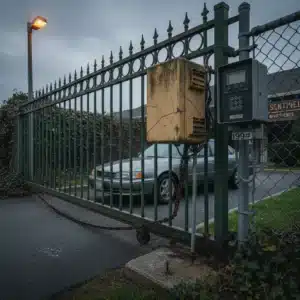
Surface rust on a steel gate is a maintenance issue. Rust that has eaten through tube walls, bottom rails, or hinge connections is a structural one. Look closely at the bottom rail and the joints, because water collects there and corrosion often starts out of sight. If you can poke through the metal or see flaking that exposes thin, pitted steel, replacement is usually more cost-effective than patching.
Sagging and dragging return after every adjustment
You can often correct a sagging gate with new hinges or a brace. If it sags again within months, the cause is probably deeper: a frame that has lost its stiffness, shifting posts, or a leaf that is simply too heavy for its hardware.
The posts are leaning, or the footings are failing
A gate is only as stable as what holds it. Leaning posts, cracked footings, or heaved concrete will keep pulling the gate out of alignment no matter how often you adjust it. Sometimes you can reset the posts, but if the gate is also worn, replacing everything at once can make more sense.
The operator is outdated, and parts are hard to find
Operators have a service life. When an old unit slows down or acts erratically, the control board keeps failing, or replacement parts are no longer available, repairs become expensive and unreliable. If the gate itself is sound, you may only need to replace the operator.
The gate no longer fits how you use the property
Sometimes the gate is fine, but your needs have changed. Larger vehicles, heavier traffic, a new need for privacy, or a requirement for access control can outgrow a gate that was installed for a different use. If a gate can’t do the job today, replace it, even if it still moves.
Repair or Replace: A Quick Comparison
| Symptom | Often repairable | Points toward replacement |
| Sagging or dragging | Worn hinges, loose posts, or a missing brace | Frame is twisted or sags again soon after repair |
| Rust | Surface rust that can be treated and refinished | Rust-through at tubes, rails, or hinge connections |
| Operator problems | A failed motor or board on a sound gate | Obsolete operator, unavailable parts, and a worn gate too |
| Safety | Adding sensors or correcting a pinch point | The gate design cannot be made safe with a reasonable retrofit |
| Cracked welds | A single isolated crack from impact | Repeated cracks in several places |
| Appearance and use | Refinishing, new hardware, added access control | The gate no longer suits the property’s traffic or security needs |
Safety: Why Older Automatic Gates Deserve a Closer Look
Safety is often the strongest reason to replace an older automatic gate. In 2001, the U.S. Consumer Product Safety Commission explained that a safety standard for automatic security gates, adopted by UL in March 2000, requires at least two entrapment-prevention mechanisms, and noted that many older gates lack sensing devices or reversing mechanisms. The agency advised owners of older gates to replace them with a gate that meets the standard.
The standards world has kept moving since then. ASTM International publishes construction standards for commercial and automated gates, including F2200, F900, and F1184, and its own write-up, Hidden Dangers of Gates, discusses hazards such as entrapment. If your automatic gate was installed long ago, has no photo eyes or edge sensors, or doesn’t reverse when it hits an obstruction, treat that as a serious warning sign. A technician can tell you whether it can be upgraded or whether replacement is the safer path.
What Replacing a Gate Involves
Replacement is a bigger project than a repair, but it is usually more straightforward than owners expect. A good gate installation team will assess the opening, the posts and footings, the existing operator and wiring, and how the gate is used. Then they design, fabricate, finish, and install it. If you are wondering about the schedule, our post on how long gate installation takes walks through the stages.

Replacement is also a chance to fix what was wrong with the old gate. If wind was the problem, a different infill can help. If the operator was always overloaded, a lighter or better-balanced design can fix it. If security or access control has changed, the new gate can be built around it.
Choosing a Replacement That Lasts
Three decisions shape how long a new gate will last. The first is the material and finish. Steel is strong and can be fabricated into nearly any design, and a quality protective finish helps it withstand outdoor conditions. The second is the hardware: hinges, rollers, and tracks sized for the gate’s weight. The third is the operator, which should match the gate type, size, and how often it will run.
Custom fabrication also lets the gate fit the opening exactly, which reduces stress on the hardware. Star Steel – Gate Repair & Installation LA fabricates gates in our Van Nuys shop and has served Los Angeles since 1991, so we can build a gate around your site and security needs and install the electric gate operator and access control to match.
Frequently Asked Questions
How do I know if my gate needs repair or replacement?
Repair usually makes sense when the frame is sound, and the problem is a worn part such as a hinge, roller, or motor. Replacement makes more sense when the frame is bent or cracked, rust has reached structural joints, repairs keep recurring, or the gate lacks modern safety features.
Can I replace just the gate operator?
Yes, if the gate is structurally sound and moves freely. Replacing only the operator can restore reliable automation without replacing the gate itself.
Is an old automatic gate unsafe?
Not every old gate is unsafe, but older automatic gates often lack today’s entrapment protection. If yours has no sensors and does not reverse on contact, have a technician evaluate it.
How long should a gate last?
It depends on the material, finish, environment, hardware quality, and how often you use the gate. Regular maintenance and prompt repairs extend gate life, while neglect shortens it.
Can a rusted steel gate be saved?
Surface rust can often be treated and refinished. Rust that has weakened structural members or joints usually requires replacing sections or installing a new gate.
Talk to Star Steel – Gate Repair & Installation LA About Your Gate
If your gate has cost you time, money, or peace of mind, Star Steel – Gate Repair & Installation LA Gate Repair & Installation can inspect it and recommend repair or replacement. Call (818) 885-8979 or contact Star Steel – Gate Repair & Installation LA to schedule an evaluation and request an estimate.