Quick Answer
How do you protect a swing gate during Santa Ana winds?
To protect a swing gate in Santa Ana winds, keep it closed and latched with a positive stop or drop bolt, make sure the hinges, posts, and operator arms are tight and in good condition, avoid turning up operator force to fight the wind, and have battery backup and a manual release ready in case the power goes out. Gates with large solid panels need the most attention because they catch the most wind.
A swing gate is a hinged panel, and in strong offshore winds it behaves much like a sail mounted on a door hinge. Santa Ana gusts can slam a leaf against its stop, push it past its limits, or hold it half open while the operator struggles to close it. When the wind passes, many property owners find a bent operator arm, a cracked weld, or a gate that no longer latches.
Most wind damage to swing gates is preventable. It comes down to the gate’s design, the condition of the hinges and posts, how the operator is set up, and what you do before a wind event arrives. This guide explains what Santa Ana winds do to a swing gate and what to check before, during, and after a blow.
What Santa Ana Winds Do to a Swing Gate
The National Weather Service glossary describes Santa Ana winds as strong, hot, dust-bearing winds that descend toward Southern California’s Pacific coast. They follow an offshore pattern, show up mostly in the cooler months, and gusts can vary widely from one street to the next. Properties in canyons or on exposed hillsides often see harder gusts than flat lots.
A swing gate leaf hangs from hinges on one edge and is held shut at the other. Wind pressure on the leaf’s surface becomes leverage at the hinges, the latch, and the operator. The larger and more solid the panel, the greater that force. A tall privacy gate with solid steel or wood infill catches far more wind than an open picket gate of the same size.
The National Weather Service notes that sustained winds of roughly 40 to 50 mph can cause isolated wind damage. Gusts run higher than sustained speeds, so a gate can see forces well above those averages for a few seconds at a time, which is often all it takes to break something.
The four weak points we see most often
Hinges and posts. Worn hinge pins, loose bolts, and posts that have started to lean are the first things to give under repeated gusts. A gate that already sags or drags is far more likely to fail in wind because the hinges carry the load unevenly.
Latches and stops. A latch that only half engages, or a gate with no ground stop or drop bolt, can let the leaf bang open and closed in the wind. Each impact shocks the hinges and the operator.
Operator arms and brackets. On automatic swing gates, the arm that pushes and pulls the leaf takes the brunt of wind loading. Bent arms, loose bracket bolts, and cracked mounting welds are common after a windy night.
Sensors, controls, and power. Santa Ana winds carry dust and debris that can foul photo eyes and sensors, and strong winds frequently cause power outages. A gate that relies on a dead operator and has no manual release instructions can get stuck in the wrong position.
Design Choices That Reduce Wind Load
If you are building or replacing a gate in a windy area, the infill style matters more than most owners expect. The trade-off is almost always privacy against wind exposure.
| Gate infill style | How it handles wind | Trade-off |
| Open pickets or bars | Lets wind pass through, so loads on hinges and operator are lowest | Little privacy |
| Spaced slats or louvers | Passes part of the wind while screening much of the view | Less privacy than a solid panel; slat spacing needs to be planned |
| Perforated or laser-cut panels | Relieves some pressure while keeping a decorative, semi-private look | Open area varies by pattern, so wind relief varies too |
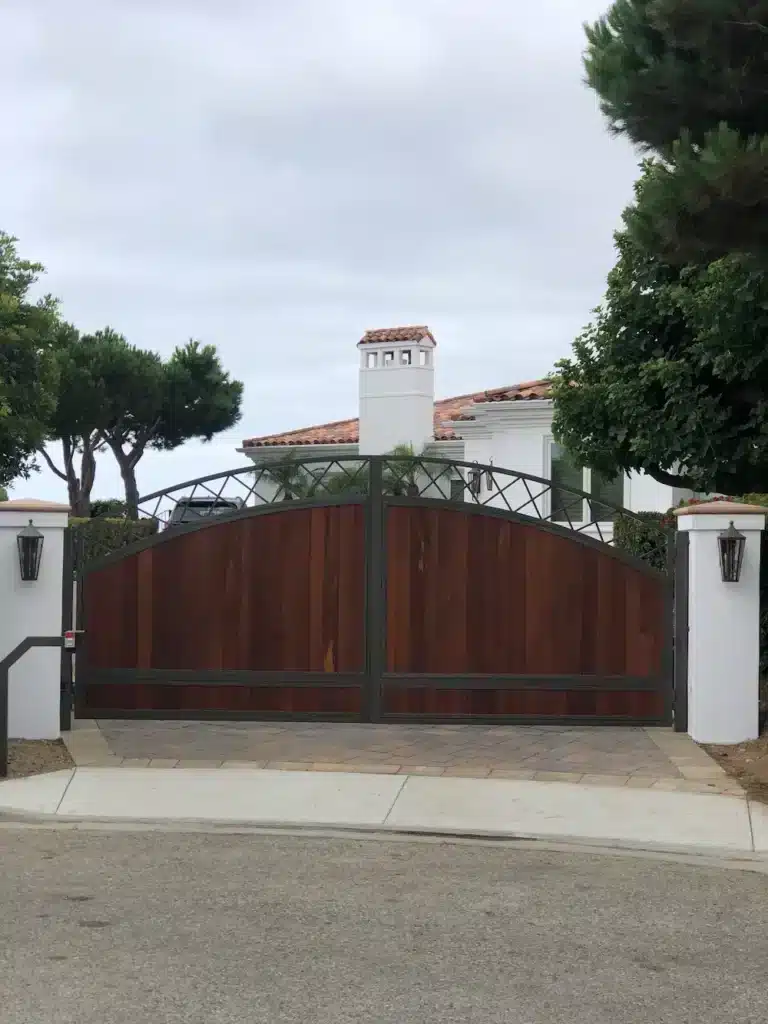
| Solid steel or wood panels | Catches the most wind and puts the highest load on hardware | Maximum privacy; needs heavier frame, hinges, and posts |
A rigid frame with proper diagonal bracing resists racking, and larger hinge plates and well-sized post footings carry loads into the ground instead of into the gate. Because we build gates in our own shop, Star Steel – Gate Repair & Installation LA can match frame thickness, bracing, slat spacing, and hinge hardware to your property’s exposure. If your current gate has been damaged more than once, swing gate repair and installation is a good place to start, since the fix is often a design change rather than another patch.

Before a Wind Event: A Practical Checklist
When the forecast calls for offshore winds, a few minutes of inspection can prevent a costly repair. Go through these steps in order:
- Check each hinge for play, worn pins, loose bolts, or cracked welds, and lubricate where the manufacturer specifies.
- Look at the gate posts for lean and the footings for cracks or movement.
- Confirm the latch, drop bolt, or ground stop engages fully and holds the gate firmly closed.
- Inspect the operator arm and its brackets for bends, loose fasteners, or slop.
- Clean photo eyes and sensors and confirm they are aligned.
- Test the manual release and the battery backup so you know both work before you need them.
- Clear loose items such as planters, trash bins, and stray panels that wind could throw into the gate.
What to Do During High Winds
Keep the gate closed and latched whenever possible. Do not stand in the swing path, and do not try to hold a gate against a gust by hand. If the leaf is moving on its own, stay clear until the gusts ease.
With an automatic gate, resist the urge to turn up the operator’s force setting to push through the wind. The operator’s job is to move and hold the gate, and its obstruction detection is part of the safety system that protects people and vehicles. Follow the manufacturer’s instructions for any adjustment, and if the gate keeps struggling in gusts, stop cycling it and call a technician. Our guide to gate safety laws in California explains why those safety features matter.
If the power goes out, know where the manual release is and how to re-engage it afterward. If you release the gate to open it by hand, secure it manually when you are done so it cannot swing freely.
After the Wind: Inspect Before You Reuse the Gate
Check the gate in daylight once the wind has dropped. Look for a leaf that now drags or sags, a latch that no longer lines up, new noises, a bent or slipping operator arm, cracked paint along weld seams, leaning posts, or loose fence panels beside the gate. Paint that has cracked at a weld is often the first sign the steel underneath has cracked too.
Do not keep running a gate that looks damaged. A bent arm or cracked weld can fail completely on the next gust or the next cycle. Star Steel – Gate Repair & Installation LA repairs swing gates and hinges, provides electric gate repair for operators, and our Van Nuys fabrication shop lets us weld, reinforce, or rebuild frames and arms instead of working around damaged parts. We service major operator brands, including LiftMaster, DoorKing, Ramset, Viking, and FAAC.
When to Repair, Reinforce, or Redesign
Minor wind damage, such as a loose latch or slightly misaligned leaf, usually calls for adjustment or replacement hardware. Moderate damage, such as a sagging frame or worn hinges, often means welding, reinforcement, and new hinge hardware. If a solid-panel gate has been damaged more than once, or the operator is repeatedly overloaded, the better long-term answer may be a redesign with spaced slats or a heavier frame so the gate is built for the wind it actually sees.
Frequently Asked Questions
Can Santa Ana winds damage an automatic swing gate operator?
Yes. Wind loads the gate leaf, and that load travels through the operator arm, brackets, and mounting points. Repeated gusts can bend arms, loosen fasteners, or overload the motor, especially on large solid gates.
Should I leave my swing gate open or closed during high winds?
Closed and latched is generally safest for the gate, because an open leaf can catch the wind, swing hard, and slam against its stop. Make sure the latch or drop bolt is holding firmly.
Are solid privacy gates a bad idea in windy areas?
Not necessarily, but they need more engineering. A solid panel should have a stronger frame, bracing, heavier hinges, and well-set posts. If privacy matters less, spaced slats reduce wind load.
What should I do if my gate stops working during a power outage?
Use the manual release per the manufacturer’s instructions, then secure the gate by hand afterward. A battery backup can keep the operator running through short outages.
How often should a swing gate be inspected?
Check it before the windy season starts, after any major wind event, and have it professionally serviced on the operator manufacturer’s recommended schedule.
Get Your Swing Gate Ready for Wind Season
If your gate sags, bangs, or shows damage after a windy night, don’t wait for the next gust. Star Steel – Gate Repair & Installation LA Gate Repair & Installation can inspect your gate, repair damage, and recommend reinforcement or a wind-smart redesign, all built in our own shop. Call (818) 885-8979 or contact Star Steel – Gate Repair & Installation LA to request a free estimate.