Quick Answer
How much security does an iron fence actually add?
The measure that matters is delayed forced-entry time. Most intruders abandon an attempt if they cannot cross the property line within about a minute, and wood, vinyl, or chain link fail that test against basic hand tools. Iron and steel pickets resist cutting and prying long enough to break off the attempt. Design drives the rest: narrow picket spacing prevents squeezing through, pointed or rolled tops defeat climbing, and extra height alone is less effective than correct spacing and anti-climb detailing.
Most property owners look at a perimeter fence and evaluate it strictly on curb appeal. However, security professionals view perimeters through a completely different lens known as delayed forced entry time. According to field research compiled by the National Criminal Justice Reference Service, a burglar typically abandons a break in attempt if they cannot breach a property line within sixty seconds. Lightweight barriers like wood, vinyl, or chain link can be compromised in moments with basic hand tools, making them minor speed bumps rather than real obstacles.
True heavy duty iron fencing completely changes this equation. It provides a dense structural matrix that is incredibly difficult to cut, climb, or breach without high powered industrial machinery.
Whether you are protecting a historic residential estate in Los Angeles or securing a high value commercial logistics facility, understanding the physics and psychological impact of iron fencing will help you design a highly secure perimeter.
The Psychological Deterrent: Crime Prevention Through Environmental Design
In the security sector, the most effective defense is a crime that never starts. Security specialists apply a framework called Crime Prevention Through Environmental Design (CPTED), which emphasizes clear physical indicators of ownership and control.
Establishing Clear Territorial Reinforcement
An iron perimeter sends an immediate signal to opportunistic criminals that a property is actively managed and heavily defended. Unlike solid privacy fences, which paradoxically create excellent hiding spots once a trespasser gets over them, iron provides what security personnel call natural surveillance.
It keeps the entire perimeter fully visible to neighbors, security cameras, and passing patrol vehicles while maintaining an imposing physical boundary.
Eliminating the Quiet Breach
Most residential burglaries are quiet, fast operations. A criminal can cut through a chain link grid using pocket sized bolt cutters in under ten seconds, or kick through a wooden privacy slat with minimal noise.
Iron pickets are made of solid or thick walled tubular structural metal that requires an angle grinder or a cutting torch to sever. The extreme noise, bright sparks, and extended time required to cut through iron make a stealthy breach virtually impossible in an urban environment.
The Counter Intuitive Security Angle: Why Extra Height Isn’t Always the Answer
When property managers or homeowners become anxious about security, their first instinct is often to build the tallest wall possible. Many assume that a ten foot solid masonry block wall is inherently safer than a six foot iron fence. This is a common and dangerous misconception.
High, solid walls introduce significant security vulnerabilities. They block your security cameras from capturing the street level activity outside your property line. Once an intruder scales a solid wall, they are completely shielded from view, allowing them to take their time bypassing your window locks or garage doors.
A standard height iron fence topped with pointed finials provides vastly superior protection. It forces intruders to expose themselves to view during a difficult climb, while ensuring your automated perimeter cameras maintain a clear, unobstructed line of sight down the entire block.
Technical Comparison of Boundary Materials
To understand why iron remains the standard for serious property protection, let us evaluate the structural capabilities of common fencing materials under real world attack scenarios.
| Material Type | Resistance to Hand Tools | Climb Difficulty Factor | Structural Life Under Attack | Interlocking Stability |
| Traditional Wood | Low (can be kicked or sawed) | Low (provides easy foot placement) | Low (snaps under focused impact) | Low (panels rely on small nails) |
| Standard Vinyl | Low (easily shattered or melted) | Low (smooth but flexible panels) | Low (cracks instantly on impact) | Low (hollow interlocking tabs) |
| Chain Link | Very Low (cut with pliers) | Very Low (acts as a built in ladder) | Moderate (stretches but holds) | Low (relies on single tension wires) |
| Heavy Duty Iron | Extremely High (requires power tools) | High (smooth vertical rails, zero footholds) | Extremely High (absorbs severe impacts) | Extremely High (fully welded joints) |
Anti Climb Engineering and Design Configurations
An iron fence can be customized to counteract specific security threats. By selecting the right structural specifications during the design phase, you can make climbing your perimeter practically impossible.
Vertical Picket Design and Spacing
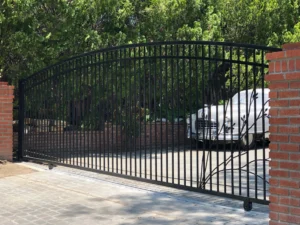
Standard decorative fencing often utilizes wide gaps between pickets. A high security configuration keeps picket spacing at less than four inches apart.
This tight alignment prevents intruders from gaining a secure foothold or using their body leverage to squeeze between the rails. Furthermore, the completely smooth vertical surface offers no horizontal cross members for feet to grip, rendering climbing attempts highly visible and physically exhausting.
Terminal Top Design Options
The top of the fence is your primary defensive line. Instead of smooth, rounded tops, security iron utilizes sharp, pointed finials or classic spear heads.
/ \ / \ / \ [Pointed Security Finials]
| | | | | |
| | | | | | [Solid Vertical Iron Pickets]
| | | | | |
============================= [Heavy Duty Horizontal Structural Rail]
For high risk commercial locations, these pickets can be outward curved at a forty five degree angle, creating an imposing physical overhang that stops climbers from scaling the top rail.
Seamless Integration with Modern Access Control Systems
A perimeter fence is only as secure as its entry points. The structural density of iron makes it the perfect foundation for automated access control technology.
Defending Against Automated Gate Failures
Automated driveway gates are a frequent target for forced entries. Lightweight gates can be warped, pried open, or lifted off their tracks using a standard vehicle jack.
Heavy iron gates resist these physical prying forces due to their high torsional rigidity. When paired with heavy duty magnetic locks capable of withstanding thousands of pounds of direct holding force, an iron entry point becomes just as secure as the surrounding wall.
Supporting Advanced Security Hardware
Modern security requires the integration of cameras, intercoms, and automated gate operators. Iron posts provide a rigid, vibration free platform for mounting sensitive long range motion sensors, laser tripwires, and high definition license plate recognition cameras.
The hollow interior of structural iron posts also serves as a secure, armored conduit for running electrical wiring, protecting your data cables from intentional cutting or environmental degradation.
Implementation Protocol: Building a Secure Iron Boundary
If you are currently managing a residential upgrade or a commercial development project, follow this four step framework to ensure your iron installation achieves maximum security effectiveness.
Step 1: Calculate the Dynamic Force Requirements
Before ordering panels, determine the likely threat profile of your area. Residential projects generally focus on delaying foot traffic and climbing attempts. Commercial facilities near high traffic roads should specify heavy gauge, solid iron pickets welded to structural steel backing posts deeply anchored in reinforced concrete to protect against potential vehicle impacts.
Step 2: Optimize the Ground Clearance Zone
A frequently overlooked security flaw is the gap between the bottom rail of the fence and the ground. Ensure your iron panels are engineered to sit no more than two inches above the finished grade. If your property features soft soil or landscaping beds, install a subterranean concrete grade beam beneath the fence line to prevent intruders or animals from digging under the perimeter.
Step 3: Verify the Hinge and Weld Integrity
Ensure all structural connections are fully welded around the entire circumference of the joints rather than spot welded. Check that the gate hinges are enclosed or tamper resistant, preventing intruders from using a crowbar to lift the moving gate panels completely off their pivot points.
When standard options won’t suffice, custom engineering makes all the difference. Our team at Star Steel specializes in high-precision steel fabrication and professional installation tailored to your exact security requirements.
If you are currently planning an automated residential gate system or upgrading perimeter defenses for a commercial facility, let’s talk.
Schedule a Consultation with Our Team
Found this guide helpful? Forward it to a building manager or developer looking to elevate their property’s perimeter protection.